

The festival is associated with two major stories from Hindu tradition: Lord Rama's victory over the demon king Ravana and Goddess Durga's victory over the buffalo demon Mahishasura. These stories represent the triumph of righteousness, courage, divine power, and justice over evil forces.
In 2026, Dussehra will be celebrated on Tuesday, October 20, according to commonly published Hindu festival calendars. The exact observance and auspicious timings may vary by location and local Panchang.
Dussehra 2026 Date and Important Details
Here are the key details about Dussehra in 2026.
- Festival Name: Dussehra
- Also Known As: Vijayadashami, Dasara
- Date: Tuesday, October 20, 2026
- Month: Ashwin, according to the Hindu lunar calendar
- Tithi: Ashwin Shukla Dashami
- Religious Significance: Victory of good over evil
- Major Celebrations: Ravan Dahan, Ramlila, Durga Puja Vijayadashami, and Shami Puja in some regions
Dussehra falls on the tenth day of the bright fortnight of the Hindu month of Ashwin. It follows the nine days of Navratri and coincides with the concluding celebrations of Durga Puja in many parts of India.
Devotees are advised to check their local Panchang for the precise Dashami tithi and auspicious timings.
What Is Dussehra ?
Dussehra is a Hindu festival that celebrates the victory of righteousness over evil. The name is commonly explained as a combination associated with the defeat of the ten-headed Ravana, although the festival's name and interpretations vary across traditions.
The festival is called Vijayadashami because Vijaya means victory and Dashami refers to the tenth lunar day.
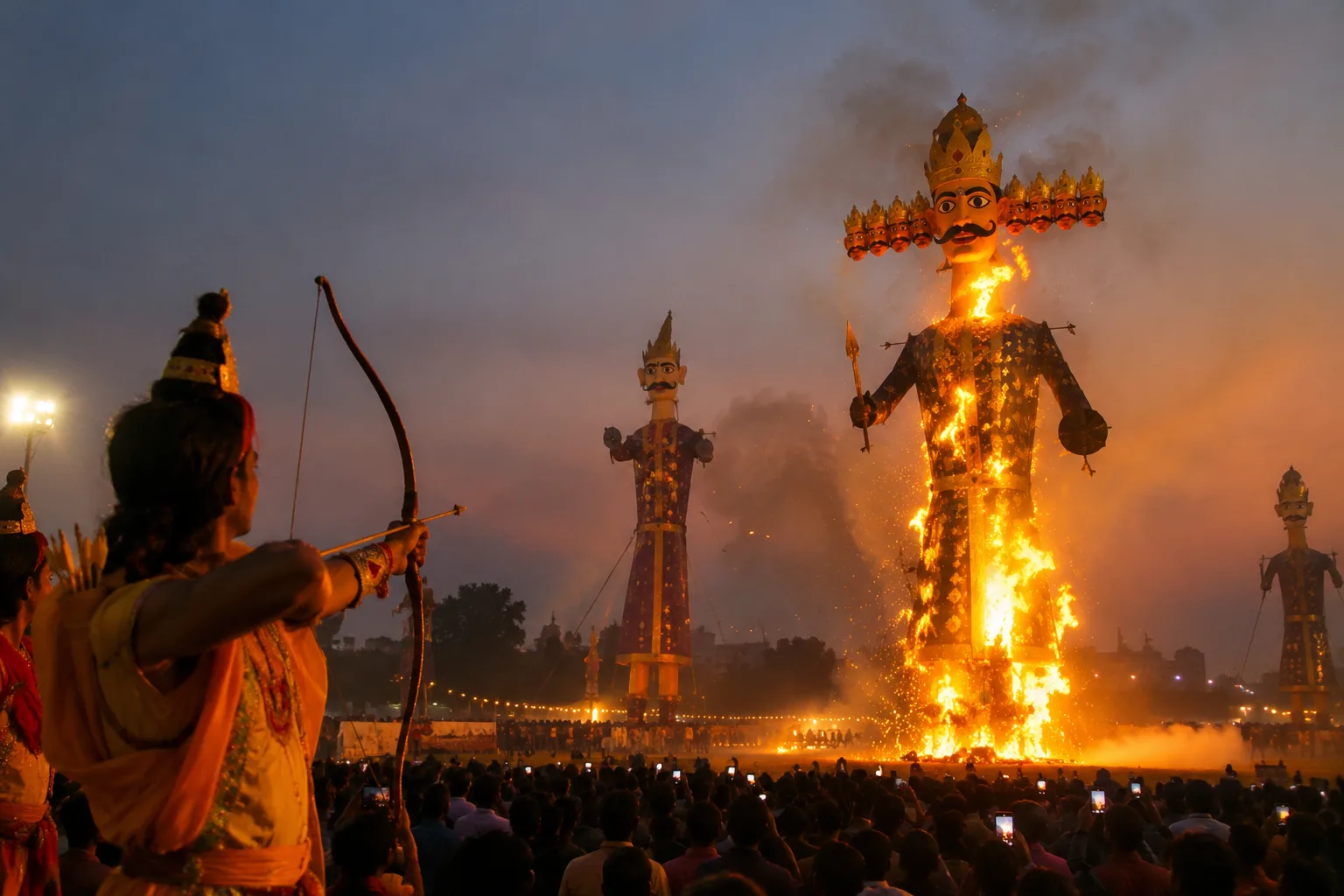
In northern and central India, Dussehra is widely celebrated through Ramlila performances, which narrate episodes from the Ramayana, followed by the burning of large effigies of Ravana, Meghnada, and Kumbhakarna.
In West Bengal and several eastern Indian states, Vijayadashami marks the conclusion of Durga Puja. Devotees bid farewell to Goddess Durga after celebrating her victory over Mahishasura.
Although the rituals differ from region to region, the central message remains the same: evil, pride, and injustice must ultimately give way to truth and goodness.
History and Mythological Significance of Dussehra
Dussehra has deep roots in Hindu mythology and is associated with important events described in religious epics and traditions.
1. Lord Rama's Victory Over Ravana
One of the most widely recognized stories associated with Dussehra comes from the Ramayana.
According to the epic, Ravana, the powerful king of Lanka, abducted Sita, the wife of Lord Rama. Rama, together with Lakshmana, Hanuman, and an army of Vanaras, travelled to Lanka to rescue her.
A great battle followed between Rama's forces and Ravana's army. After a fierce struggle, Lord Rama defeated Ravana, ending his rule of injustice and rescuing Sita.
This victory is commemorated on Dussehra through Ramlila performances and Ravan Dahan, in which effigies of Ravana are set alight.
The story teaches that intelligence and power without morality can lead to destruction, while courage guided by righteousness can overcome even the greatest challenges.
2. Goddess Durga's Victory Over Mahishasura
Another important tradition links Vijayadashami to Goddess Durga's victory over Mahishasura, a powerful demon who threatened the gods and the world.
According to Hindu tradition, the gods joined their divine energies to create Goddess Durga, who fought Mahishasura in a prolonged battle. She ultimately defeated him, restoring balance and protecting the universe.
This victory is celebrated during Durga Puja, particularly in West Bengal, Assam, Odisha, and other eastern regions.
On Vijayadashami, devotees bid farewell to the goddess and pray for prosperity, protection, and well-being.
The story represents the power of divine feminine energy and the triumph of justice over oppression.
Why Is Dussehra Celebrated ?
Dussehra is celebrated to honor the victory of good over evil and to encourage people to follow the path of truth, discipline, and righteousness.
The festival carries several important messages:
- Victory of truth: Truth and justice should prevail over deception and wrongdoing.
- Destruction of arrogance: Ravana's defeat reminds people that pride and misuse of power can lead to downfall.
- Courage and determination: Lord Rama's journey teaches the importance of perseverance in difficult circumstances.
- Respect for women: The Ramayana narrative highlights the need to oppose injustice and protect human dignity.
- Spiritual renewal: Vijayadashami encourages people to leave behind negative habits and begin new efforts with confidence.
Dussehra is therefore not only a religious celebration but also an opportunity for personal reflection and moral renewal.
How Is Dussehra Celebrated in India ?
Dussehra is celebrated in different ways throughout India, reflecting the country's diverse regional traditions.
1. Ravan Dahan in North India
In Delhi, Uttar Pradesh, Haryana, Rajasthan, and other northern regions, one of the main attractions of Dussehra is Ravan Dahan.
Large effigies of Ravana, Meghnada, and Kumbhakarna are erected in open grounds. After religious ceremonies and Ramlila performances, the effigies are set on fire, often accompanied by fireworks and public celebrations.
Families gather to watch the event and remember Lord Rama's victory.
2. Ramlila Performances
Ramlila is a dramatic presentation of episodes from the Ramayana. Performers portray Lord Rama, Sita, Lakshmana, Hanuman, Ravana, and other characters.
These performances often take place over several days during Navratri and conclude around Dussehra.
Ramlila helps preserve traditional storytelling and introduces younger generations to the moral and spiritual lessons of the Ramayana.
3. Vijayadashami in West Bengal
In West Bengal, Vijayadashami marks the final day of Durga Puja.
Devotees offer prayers to Goddess Durga, participate in farewell rituals, exchange greetings, and take part in the immersion of Durga idols.
The day is associated with the goddess's return to her divine abode after visiting the earthly world.
4. Mysuru Dasara in Karnataka
Mysuru Dasara is among India's most famous Dussehra celebrations. The festival features cultural programmes, music, traditional performances, illuminated landmarks, and a grand procession known as Jamboo Savari.
The celebrations are closely associated with the royal heritage of Mysuru and its worship of Goddess Chamundeshwari.
Visitors from across India and abroad attend the festivities to experience Karnataka's cultural traditions.
5. Kullu Dussehra in Himachal Pradesh
Kullu Dussehra is distinctive because its major celebrations begin on Vijayadashami and continue for several days.
Deities from surrounding villages are brought in traditional processions to participate in the festival. The event features religious ceremonies, folk music, cultural programmes, and gatherings that showcase the region's rich traditions.
Unlike the typical Ravan Dahan celebrations elsewhere, Kullu Dussehra has its own distinctive customs and devotional character.
6. Dussehra in Maharashtra
In Maharashtra, Vijayadashami is associated with worship, family gatherings, and the exchange of Apta leaves, which are traditionally regarded as symbolic gold.
Many people also consider the day auspicious for beginning new work, purchasing useful items, or undertaking educational and professional activities.
7. Ayudha Puja and Vijayadashami in South India
In Karnataka, Tamil Nadu, Andhra Pradesh, Telangana, and neighbouring regions, Dussehra celebrations may include Ayudha Puja, during which tools, machinery, vehicles, books, and instruments are honoured.
The ritual expresses gratitude for the tools and skills that support daily work and livelihoods.
Vijayadashami is also considered an auspicious day to begin learning, including music, dance, and formal education, in several South Indian traditions.
Religious and Spiritual Significance of Dussehra
The deeper meaning of Dussehra extends beyond mythological battles and public celebrations.
Ravana is often interpreted as a symbol of negative qualities such as arrogance, uncontrolled desire, anger, greed, and misuse of knowledge. Although he is portrayed in the Ramayana as highly learned and powerful, his choices ultimately bring about his downfall.
Lord Rama represents righteousness, self-control, responsibility, and devotion to duty. His victory reminds devotees that success should be guided by moral principles.
Similarly, Goddess Durga's victory over Mahishasura symbolises the destruction of oppression and the restoration of harmony.
Dussehra encourages people to examine their own behavior, overcome harmful habits, and develop qualities such as compassion, honesty, courage, and humility.
The Ten Heads of Ravana and Their Symbolic Meaning
In popular interpretations, Ravana's ten heads are associated with various negative human tendencies. Different traditions offer different explanations, so there is no single universally accepted list.
Commonly mentioned qualities include:
- Anger
- Pride
- Greed
- Attachment
- Lust
- Envy
- Selfishness
- Injustice
- Arrogance
- Excessive desire or uncontrolled ambition
The symbolism encourages people to recognize and overcome their inner weaknesses. Ravan Dahan can therefore be understood as a reminder that the defeat of evil begins with self-awareness and positive action.
What Should People Do on Dussehra ?
Devotees observe Dussehra according to their family customs, regional traditions, and religious beliefs.
Common practices include:
- Offering prayers to Lord Rama, Goddess Durga, or other family deities.
- Visiting temples and participating in religious ceremonies.
- Watching Ramlila performances and Ravan Dahan.
- Taking part in Vijayadashami or Durga Puja rituals.
- Honoring tools, books, instruments, or work equipment where Ayudha Puja is observed.
- Spending time with family and sharing festive greetings.
- Beginning a new educational, creative, or professional activity according to personal tradition.
Is Dussehra a Public Holiday in India ?
Dussehra is widely observed as a public holiday in many Indian states, government offices, schools, and educational institutions. However, the exact holiday arrangements vary by state, employer, and institution.
The date and local observance should be confirmed through the relevant state government holiday calendar or institutional notice.
Dussehra Wishes and Greetings
Here are a few greetings you can share with friends, family, or readers.
- Happy Dussehra! May the victory of good over evil inspire you to live with courage, honesty, and kindness.
- May Lord Rama bless you with strength, wisdom, and success. Wishing you and your family a joyful Vijayadashami.
- On this auspicious Dussehra, may negativity disappear from your life and peace, prosperity, and happiness flourish.
- May Goddess Durga bless everyone with courage, protection, and the strength to overcome every difficulty.
- Let this Dussehra remind us that truth, patience, and righteousness always deserve our commitment.
Dussehra is a festival of victory, faith, courage, and renewal. Through Lord Rama's victory over Ravana and Goddess Durga's triumph over Mahishasura, the festival conveys the timeless message that evil and injustice must be challenged and that righteousness deserves to be upheld.
From Ravan Dahan and Ramlila in northern India to Mysuru Dasara, Kullu Dussehra, and Durga Puja Vijayadashami, the festival reflects the cultural diversity of India.
As Dussehra 2026 approaches, the occasion offers an opportunity to celebrate with family, honor cherished traditions, and reflect on the values that make life more meaningful. Its most lasting lesson is that the victory of good begins with the choices people make in their own lives.
Comments
0