







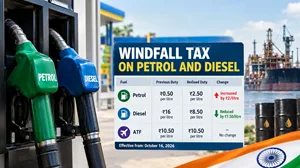
The Centre has increased the windfall tax on petrol exports to ₹2.50 per litre while reducing the levy on diesel exports to ₹8.50 per litre. The revised rates came into effect on October 16, 2026, as the government continues to adjust fuel export duties in response to international oil market conditions.
India has revised its windfall tax on petrol and diesel exports, increasing the levy on petrol fivefold and cutting the duty on diesel nearly in half. The move highlights the government's continuing efforts to balance domestic fuel availability, international price fluctuations and the commercial interests of petroleum refiners.
Under the latest revision, the export duty on petrol has risen from ₹0.50 to ₹2.50 per litre, while the duty on diesel has fallen from ₹16 to ₹8.50 per litre. The government has also retained the existing export levy on aviation turbine fuel (ATF) at ₹10.50 per litre. The new rates apply from October 16, 2026.
Windfall Tax on Petrol and Diesel: Latest Rates
The revised export duties are summarized below.
| Fuel | Previous duty | Revised duty | Change |
|---|---|---|---|
| Petrol | ₹0.50/litre | ₹2.50/litre | Increased by ₹2/litre |
| Diesel | ₹16/litre | ₹8.50/litre | Reduced by ₹7.50/litre |
| Aviation turbine fuel (ATF) | ₹10.50/litre | ₹10.50/litre | No change |
Effective date: October 16, 2026.
As per the Economic Times, The petrol export levy has increased fivefold, whereas the diesel levy has been reduced by approximately 46.9%. These changes concern the applicable export duties on petroleum products, not a direct increase in the retail price of petrol or diesel sold at Indian fuel stations
What Is a Windfall Tax ?
A windfall tax is a tax imposed by the government on unusually high profits or gains earned by businesses under exceptional market conditions. Such gains may arise when international commodity prices rise sharply, allowing producers or companies to earn significantly higher margins than usual.
In the petroleum sector, governments may use windfall taxes and export duties to address situations in which selling fuel overseas becomes more attractive than supplying the domestic market.
For example, if international diesel prices rise substantially, Indian refiners may have an incentive to export more diesel to countries offering higher prices. This can create concerns about the availability of petroleum products within India.
By imposing or adjusting export duties, the government can reduce the financial incentive to export fuel and encourage refiners to maintain adequate domestic supplies.
In India's current framework, these measures include the Special Additional Excise Duty (SAED) and, where applicable, the Road and Infrastructure Cess (RIC). News reports commonly refer to these export levies collectively as windfall taxes.
Why Has the Government Revised Windfall Taxes ?
The government introduced export levies on diesel and aviation turbine fuel on March 27, 2026, amid the West Asia crisis. The levy on petrol exports was introduced from May 16, 2026. Since then, the applicable rates have been revised periodically to reflect changing international market conditions.
The principal objectives of the policy include:
- Maintaining domestic fuel availability: Discouraging excessive exports when international markets offer more attractive prices.
- Responding to global oil price movements: Adjusting duties as international crude oil and refined fuel prices change.
- Managing export incentives: Reducing the financial advantage of selling fuel overseas when domestic supply is a priority.
- Balancing the interests of refiners and consumers: Adjusting levies to reflect changing conditions in the domestic and international energy markets.
The contrasting changes in petrol and diesel duties show that the government is not applying the same tax adjustment to every petroleum product. The latest notification changes the duties separately according to the product concerned.
How Does the Windfall Tax Work ?
The impact of a windfall tax depends on the quantity of fuel exported and the duty applicable to each litre.
Consider a hypothetical exporter shipping one million litres of petrol or diesel.
| Particulars | Petrol | Diesel |
|---|---|---|
| Export quantity | 10 lakh litres | 10 lakh litres |
| Previous duty per litre | ₹0.50 | ₹16 |
| Revised duty per litre | ₹2.50 | ₹8.50 |
| Previous total duty | ₹5 lakh | ₹1.60 crore |
| Revised total duty | ₹25 lakh | ₹85 lakh |
| Change in duty liability | Increase of ₹20 lakh | Reduction of ₹75 lakh |
The example demonstrates that petrol exporters face a higher duty burden under the new rates, while diesel exporters benefit from a lower levy. The ultimate effect on an exporter's profitability will also depend on international selling prices, crude oil costs, refining margins, freight and other expenses.
Will Petrol and Diesel Prices Increase ?
One of the most important questions for consumers is whether the revised windfall tax will make petrol and diesel more expensive at domestic fuel stations.
The revised export duties do not directly increase the tax payable on petrol and diesel sold for domestic consumption. The government has maintained a distinction between the export levies and the existing duties on fuel supplied to the domestic market.
Consequently, the increase in petrol export duty from ₹0.50 to ₹2.50 per litre should not be interpreted as an automatic ₹2 increase in the retail price of petrol. Similarly, the reduction in diesel export duty does not guarantee an immediate reduction in diesel prices at fuel stations.
Retail prices can be influenced by several factors, including:
- International crude oil prices.
- Refining and marketing costs.
- Central and state taxes applicable to domestic fuel sales.
- Transportation and distribution expenses.
- Pricing decisions by oil marketing companies.
Therefore, consumers should distinguish between changes in export duties and changes in the retail prices announced by fuel retailers.
How Could the Changes Affect Oil Companies ?
The revised duties could have different implications for refiners and petroleum exporters.
1. Petrol exporters
The increase in the petrol export duty raises the tax cost of exporting each litre. Depending on international prices and refining margins, this may reduce the profitability of certain export transactions or encourage companies to reconsider their export volumes.
2. Diesel exporters
The reduction in the diesel levy from ₹16 to ₹8.50 per litre lowers the applicable duty burden. This could improve export economics compared with the previous rate, although the actual benefit will depend on prevailing market conditions.
3. Oil marketing companies
Companies involved in refining, marketing and exporting petroleum products may need to adjust their supply and export strategies in response to changes in duties and global demand.
4. Government revenue
Higher duties can increase the amount collected per litre on a particular product, while lower duties can reduce the tax collected on the affected export volume. The overall revenue effect depends on export quantities, product prices and subsequent revisions.
Why Are Windfall Taxes Reviewed Frequently ?
Petroleum markets can change rapidly because of geopolitical tensions, production decisions, shipping disruptions, changes in global demand and fluctuations in crude oil prices.
A fixed export duty may become less suitable when market conditions change significantly. Periodic revisions allow the government to respond to these developments rather than maintain an unchanged levy indefinitely.
India's export levies have been reviewed on a fortnightly basis during the current policy period. The government has linked revisions to movements in international crude oil and petroleum product prices.
This approach gives policymakers the flexibility to raise duties when export incentives or domestic supply concerns increase and reduce them when market conditions change.
However, frequent revisions can also create uncertainty for exporters, who must plan contracts, shipments and refining operations around changing tax costs.
Background: India's Windfall Tax Policy
India first introduced windfall taxes on petroleum products in July 2022, when elevated global energy prices created opportunities for oil producers and refiners to benefit from exceptional market conditions.
The government subsequently withdrew the export-related levies in 2024. In March 2026, it reintroduced export duties on diesel and aviation turbine fuel amid renewed volatility in international energy markets. Petrol exports were brought under the levy in May 2026.
Since the reintroduction, the government has adjusted the applicable rates several times. The latest revision, effective October 16, 2026, increases the petrol export duty and reduces the diesel export duty.
The policy reflects a broader challenge for an energy-importing country such as India: ensuring adequate domestic fuel availability while allowing its refining industry to participate in international markets.
What Should Consumers and Investors Watch Next ?
Consumers should monitor domestic retail fuel prices separately from export duty notifications. An adjustment in the export levy alone is not sufficient evidence that pump prices will rise or fall.
Investors and industry observers, meanwhile, should watch the following developments:
- Future fortnightly revisions to petrol, diesel and ATF export duties.
- Changes in international crude oil and refined product prices.
- Export volumes and domestic fuel availability.
- Refining margins and the financial performance of petroleum companies.
- Any official announcement affecting domestic fuel taxes or retail pricing.
The direction of future duty revisions will depend on changing market conditions and government policy decisions. The current rates should not be assumed to remain unchanged beyond the applicable period.
The Centre's latest windfall tax revision, effective October 16, 2026, raises the petrol export duty from ₹0.50 to ₹2.50 per litre while cutting the diesel export levy from ₹16 to ₹8.50 per litre. The duty on aviation turbine fuel exports remains ₹10.50 per litre.
The changes underline the government's effort to manage petroleum exports and domestic fuel availability amid volatile global energy markets. While petrol exporters face a higher duty burden, diesel exporters benefit from a reduction in the levy.
For ordinary consumers, the key point is that these are export-duty changes, not automatic increases or decreases in petrol and diesel prices at domestic fuel stations. Any effect on retail prices will depend on separate pricing and market developments.






Comments
0