




1. Why Is the ICC Planning New Regulations for T20 Leagues ?
The rapid expansion of franchise T20 cricket has transformed the global cricket economy. Competitions such as the Indian Premier League (IPL), Big Bash League (BBL), Pakistan Super League (PSL), ILT20, SA20 and MLC attract international players, investors, broadcasters and sponsors.
However, this expansion has also created several challenges, including scheduling conflicts with international cricket, concerns over player payments, inconsistent league approval processes, questionable ownership arrangements and corruption risks.
The ICC believes a stronger regulatory framework could help protect international cricket while allowing franchise competitions to grow sustainably.
The proposed reforms aim to establish more consistent standards for franchise leagues operating under different national cricket boards.
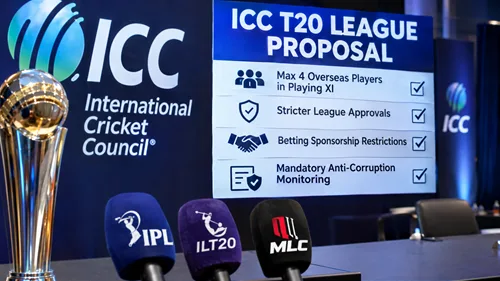
2. ICC Proposes Four Overseas Players in Playing XI
One of the most significant recommendations concerns the number of overseas players permitted in a franchise team's playing XI.
The ICC introduced regulations governing overseas player participation in 2023. However, certain established leagues received exemptions.
The review group now recommends ensuring that existing competitions comply with the four-overseas-player framework.
Current overseas player limits
T20 League Current maximum overseas playing in XI Proposed limit Indian Premier League (IPL) 4 4 International League T20 (ILT20) 9* 4 Major League Cricket (MLC) 6 4
The changes would have the greatest impact on ILT20 and MLC because both competitions currently depend heavily on international players.
ILT20 franchises could need to introduce significantly more UAE-qualified players, while MLC teams would have to increase their reliance on domestic players in the United States.
The proposal could create more opportunities for local cricketers, although franchises may face challenges in maintaining their existing team combinations.
3. How Could the Proposal Affect ILT20 and Major League Cricket ?
International League T20 (UAE)
ILT20 could face major restructuring because its teams can currently field up to nine overseas players. Reducing that number to four would increase demand for locally qualified cricketers and require changes to recruitment strategies.
Major League Cricket (USA)
MLC currently permits up to six overseas players in its playing XI. A four-player restriction could create additional opportunities for American cricketers but may also affect team strength, player recruitment and commercial planning.
Both leagues have significant connections with Indian franchise ownership groups. According to the reported recommendations, five of the six ILT20 franchises have ownership links with IPL or WPL teams, while four MLC franchises are connected to IPL ownership groups.
Consequently, the proposed changes could also affect the international franchise investment strategies of Indian cricket businesses.
4. ICC Wants Greater Authority Over Franchise League Approvals
Another important recommendation involves expanding the ICC's authority over franchise league approvals.
Under the existing framework, Full Member cricket boards generally have the authority to sanction domestic franchise leagues within their territories. Leagues organised by Associate Members require additional ICC approval.
The proposed changes would allow the ICC to review or audit approvals granted by Full Member boards.
If implemented, the ICC could intervene when a national cricket board fails to meet its regulatory obligations.
The governing body could potentially reject league applications or withdraw existing approvals where serious integrity concerns are identified.
This would represent a significant expansion of ICC oversight over franchise cricket.
5. Strict Regulations on Betting-Related Sponsorships
The ICC review group has also recommended stronger restrictions on sponsorship agreements involving betting companies and surrogate brands.
The proposal particularly targets sponsorship arrangements that facilitate betting in countries where gambling is prohibited.
According to the review group's concerns, such arrangements could expose cricket competitions to illegal betting activity, corruption risks and governance problems.
If approved, franchise leagues may need to review existing commercial partnerships and ensure that sponsors comply with applicable regulations.
6. Mandatory Anti-Corruption Monitoring
The proposed reforms would also strengthen anti-corruption oversight.
Under the recommendations, franchise leagues seeking official approval would be required to use either the ICC's Anti-Corruption Unit (ACU) or another integrity body approved by the ICC.
For competitions considered particularly vulnerable to corruption, the ICC's ACU could provide direct monitoring services.
League organizers would be responsible for covering the associated costs on a not-for-profit basis.
Applications could be rejected if organizers cannot establish adequate safeguards against corruption.
The objective is to strengthen monitoring of suspicious activities and protect the integrity of franchise competitions.
7. ICC May Introduce Approval Fees for T20 Leagues
The review group has proposed introducing a sanctioning fee for franchise competitions.
Under this recommendation, league organizers would need to pay a fee as part of the official approval process.
The collected revenue could support background checks, financial due diligence and corruption investigations.
This would add another regulatory requirement for league operators, particularly organizers planning new franchise tournaments.
The proposed fee structure and amounts have not yet been finalized.
8. Standardized Payments to National Cricket Boards
Another issue under consideration is the standardization of solidarity payments.
These payments recognize the contribution of national cricket boards to developing players who subsequently participate in overseas franchise competitions.
Currently, such payments are negotiated between the relevant boards and league organizers.
The ICC review group has suggested examining a more consistent system, potentially using a fixed percentage.
A standardized approach could reduce disputes and provide greater financial clarity for participating cricket boards.
However, this remains an issue for further discussion rather than an approved regulation.
9. Could the ICC Limit the Number of T20 Leagues in a Country ?
The review group has also raised the possibility of restricting the number of franchise competitions an individual ICC member can host.
The concern is that an excessive number of leagues could place additional pressure on international cricket schedules and player availability.
The group has additionally highlighted the need to examine regulations governing legends leagues involving retired cricketers.
These matters are still under discussion, and no confirmed numerical restriction on the number of leagues has been announced.
10. Who Is Leading the ICC Franchise League Review Group ?
The Franchise League Review Group was established in July 2026 to examine the regulatory framework governing franchise competitions.
According to the reported recommendations, the group includes:
- Tamim Iqbal: Bangladesh Cricket Board president and review group chair.
- Richard Gould: Chief Executive of the England and Wales Cricket Board.
- Todd Greenberg: Chief Executive of Cricket Australia.
- Devajit Saikia: Secretary of the Board of Control for Cricket in India (BCCI).
The group is responsible for reviewing existing regulations and recommending improvements that balance the commercial expansion of franchise cricket with the interests of national cricket boards and international competitions.
11. Will the ICC's New Proposal Affect IPL 2027 ?
The Indian Premier League already follows the four-overseas-player limit in its playing XI. Therefore, the proposed restriction is unlikely to require a major change to IPL team combinations.
However, the ICC's broader recommendations could have implications for league governance, sponsorship regulations, anti-corruption requirements and approval procedures.
The proposals may also indirectly affect IPL franchise owners who have invested in overseas competitions such as ILT20 and MLC.
Importantly, there is currently no confirmed ICC decision requiring IPL teams to reduce their overseas-player allowance below four.
The ICC's proposal should also not be confused with former IPL chairman Lalit Modi's separate suggestion to reconsider the IPL's traditional April–May scheduling window.
12. Advantages and Challenges of the Proposed ICC Rules
Potential advantages Potential challenges More opportunities for domestic players Reduced flexibility for some franchises Stronger anti-corruption safeguards Increased compliance costs More consistent league regulations Possible reduction in overseas star participation Better financial and governance oversight Changes to existing commercial agreements Greater protection for international cricket Scheduling and player availability challenges
Supporters of stronger regulations may argue that franchise cricket should contribute to developing domestic players rather than relying excessively on established international stars.
On the other hand, leagues operating in emerging cricket markets may argue that overseas players are essential for attracting audiences, sponsors and broadcasters while domestic cricket structures continue to develop.
The ICC will need to balance these competing priorities before finalizing any new regulations.
13. When Will the ICC Make a Final Decision ?
The ICC Board and Committee meetings are taking place in Bali, Indonesia, between November 11 and 15, 2026.
The Chief Executives' Committee is expected to examine the Franchise League Review Group's recommendations before relevant proposals are forwarded to the ICC Board for consideration.
The ICC's official November 11 announcement confirms that the review group will present its initial recommendations during the meetings.
As of November 12, 2026, the proposed changes remain under consideration. No final approval, implementation date or detailed transition arrangement has been confirmed.
Conclusion
The ICC's proposed regulatory reforms could mark an important turning point for global T20 franchise cricket.
The recommendations cover overseas player limits, league approvals, betting-related sponsorships, anti-corruption oversight, sanctioning fees and financial arrangements between cricket boards.
While the IPL already complies with the four-overseas-player restriction, competitions such as ILT20 and MLC could face substantial changes if their existing exemptions are removed.
The outcome of the Bali meetings will be important for determining how franchise cricket develops alongside international cricket in the coming years.
For now, the proposals remain recommendations rather than enforceable new rules.
Also Read :

Comments
0